

Risk Management · 2025
In this section4 topics
Risk Management Policy & Plan
Policy & Plan Description
The Company places importance on enterprise risk management to mitigate impacts and enhance adaptability in uncertain situations. Current business operations are increasingly challenging due to constantly changing factors, including economic conditions, intensified business competition, technological advancements, new legal changes, and the growing impact of climate change. Consequently, the Company must adapt and prepare to address risks arising from these factors. Therefore, the Company adopts an international standard risk management framework, or The Committee of Sponsoring Organizations of the Treadway Commission (COSO) has been adopted to implement enterprise-wide risk management (Enterprise Risk Management) according to the COSO – ERM 2017 risk management framework. and ISO 31000. which aligns with good corporate governance principles and supports the integration of risk management into the organizational culture. The Company has established an Enterprise Risk Management Policy to guide the Board of Directors, executives, and employees at all levels to adhere to and participate in standard risk management processes, alongside the organizational strategy-setting process. Risk management is designated as a duty for the Board, executives, and employees at all levels, who must be aware of the risks in their operations. The principles and processes of risk management are to be applied as an integral part of their work to enhance opportunities and reduce uncertainties in the overall operational performance of the organization. To further enhance the efficiency of risk management, the Company has appointed an Enterprise Risk Management Committee (RMC) responsible for defining risk management policy frameworks, overseeing and supporting the alignment of enterprise risk management operations with business strategies and goals, promoting and supporting risk management as part of the organizational culture, and continuously reporting risk status, analyzing, assessing, and managing risks to the Board of Directors and the Audit Committee.
Furthermore, the Company aims to foster a risk management culture by continuously promoting, supporting, and educating the Board of Directors, executives, and employees on risk management processes and guidelines. This is to instill awareness of the importance and shared responsibility in the organization's risk management operations among personnel at all levels, which is one of the Company's risk management policies, to ensure that risk management becomes part of a culture that leads to value creation for the organization and its stakeholders.
The Company regularly reviews, develops, and improves its enterprise risk management processes annually to adapt to the changing business environment. It continuously analyzes various risks that may affect the organization, especially in the areas of environment, social, and governance ( ESG). The Company considers risks from both internal and external organizational contexts, as well as the needs and expectations of stakeholders. It has also developed concrete risk management plans covering the entire organization, aiming to reduce various risk levels to an acceptable threshold for the organization and to build confidence among stakeholders that the Company can operate continuously amidst potential changes. The Enterprise Risk Management Committee and the Enterprise Risk Management Working Group provide continuous oversight. The Chairman of the Risk Management Working Group serves as the secretary to the Enterprise Risk Management Committee and supports risk management activities to ensure that risk management operations achieve the organization's short-term and long-term sustainable objectives and goals.
Risk Management Governance Structure and Responsibilities
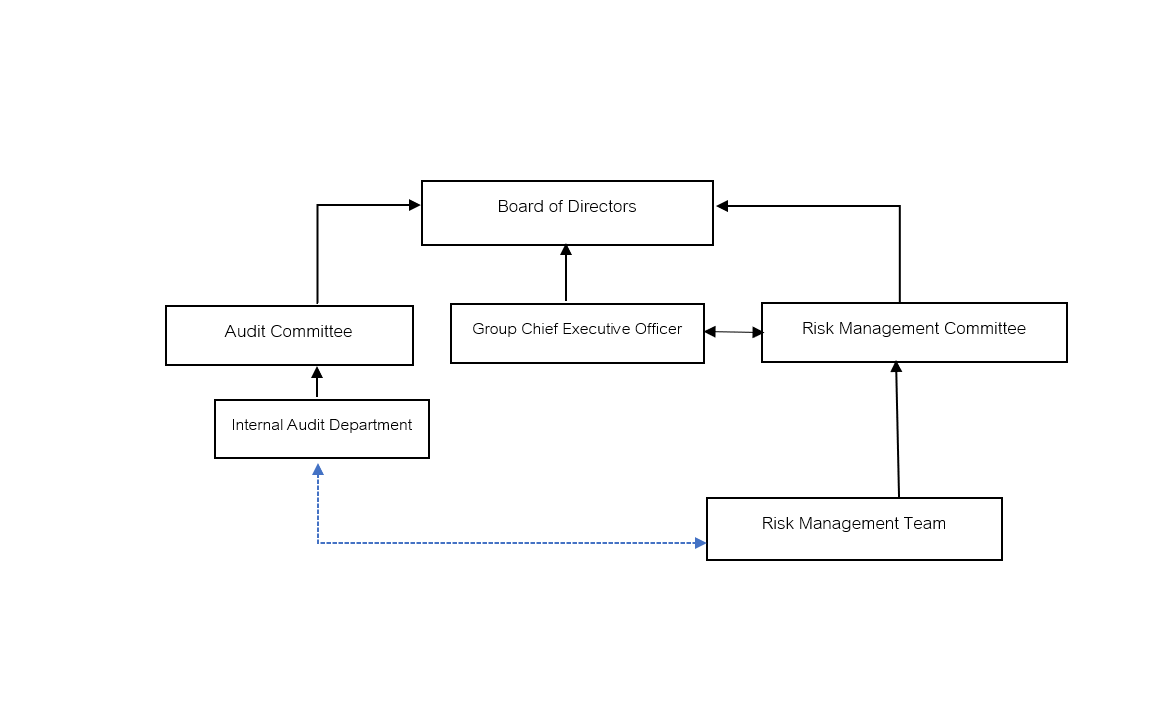 The Company clearly defines its risk management governance structure to ensure transparency, accountability, and efficiency. Roles and responsibilities are appropriately assigned at each level, starting with the Board of Directors, which oversees the overall framework and sets the organization's risk policies and direction. The Risk Management Committee is responsible for considering, reviewing, and monitoring significant risks, as well as recommending management approaches to the Board of Directors.
Senior management plays a crucial role in integrating risk management with the organization's strategy and operations. Operational and support units, including the Risk Management Team (RMT), which comprises representatives from each department, are responsible for identifying, assessing, managing, and monitoring risks at the operational level. They regularly report risk status to management and the Risk Management Committee, with monthly monitoring and quarterly reporting to the Risk Management Committee. This structure supports risk management in accordance with good corporate governance principles and the concept of Enterprise Risk Management.
Enterprise Risk Management Process
The Company defines a systematic risk management process, covering context and objective setting, risk identification, assessment and prioritization, establishment of management measures, and continuous monitoring and reporting, to align with changes in both internal and external organizational environments.
In 2025, the Company prioritizes identifying significant risks from both current business operations and future trends, considering economic factors, the logistics industry, technology, regulations, and sustainability issues. It also assesses risks based on both likelihood and impact to prioritize and determine appropriate management approaches.
Risk Appetite and Risk Tolerance
The Company defines its acceptable risk level (Risk Appetite) to serve as a framework for strategic, operational, and investment decisions, aiming to balance organizational growth and stability under prudent risk management principles.
Furthermore, the Company has defined practical risk tolerance levels for significant risks in each area for monitoring and surveillance, linking them to Key Performance Indicators (KPIs) and the Balanced Scorecard (BSC) to evaluate the performance of executives and relevant departments.
Business Continuity Plan (BCP)
The Company has developed an enterprise-level Business Continuity Plan to cope with critical events that may impact operations, such as natural disasters, civil unrest, supply chain disruptions, and public health risks.
The plan covers the identification of critical systems, the establishment of contingency and recovery plans, emergency communication, and inter-departmental coordination to maintain business continuity, minimize impact on stakeholders, and effectively support recovery.
Strengthening Risk Culture
The Company promotes a risk management culture throughout the organization by fostering awareness and understanding among employees at all levels, and by assigning executives and employees the role of "Risk Owner."
Risk management is integrated into performance evaluation through KPIs and BSC, and is also used in the consideration of developing and improving products, services, and work processes, to ensure that risk management is part of daily business operations and supports the organization's sustainable growth. In 2025, the Company organizes various risk awareness training activities and Risk Management workshops. and sends employees for training with external organizations. as well as publicizing the Risk Management Policy and providing additional channels for employees to study the risk management policy and various communication documents through the Microsoft SharePoint platform.
Tools Used in Risk Management
The Company establishes an enterprise risk management policy for employees at all levels to adhere to and implement systematically. Risk management tools are applied to continuously enhance the efficiency of risk control and monitoring, such as defining the organization's acceptable risk level (Risk Appetite) to serve as a framework for business decision-making, assessing and prioritizing risk factors through a Risk Map, and establishing control and monitoring measures through a Mitigation Plan and Key Risk Indicators (KRIs).
Furthermore, the Company emphasizes continuously monitoring and assessing changes in external factors that may affect business operations, including emerging risks. This enables the timely establishment of proactive measures to mitigate and manage risks, thereby reducing potential impacts and supporting stable and sustainable business operations.
Risk Factors — Overview
Risk Factors — Introduction
The Company systematically conducts risk analysis that may affect overall business operations (Risk Universe), covering both internal and external factors of the organization, including consideration of the organization's key objectives and strategies, as well as the needs and expectations of stakeholders.
In addition, the Company also emphasizes monitoring trends of changes in various dimensions, such as economic, social, political, and technological aspects, including the competitive landscape in the industry, to comprehensively identify and define organizational-level risk factors in line with the continuously changing business context.
Risks to the Company's Business Operations
Risk Register
| Risk Name | Risk Characteristics | Consequences | Management Measures | Related Risk Factors |
|---|---|---|---|---|
| Risks from freight rates and fuel price volatility | The Company's logistics business incurs primary costs from sea and air freight charges, as well as fuel costs for trucks and other vehicles. Freight and fuel prices fluctuate according to global market conditions, such as changes in supply and demand, global crude oil prices, and economic or political events, which can lead to rapid changes in the Company's operating costs. |
|
| 740 · Description: Shortage or fluctuation in pricing of raw materials or productive resources · Info category: OPERATIONAL_RISK |
| Investment Risk | The Company invests both domestically and internationally to expand its logistics business. Investment risks arise from the uncertainty of returns, differences in laws, government policies, economy, and culture in new markets, as well as the project's feasibility potentially being lower than anticipated. |
|
| 1716 · Description: New business risk · Info category: STRATEGIC_RISK |
| Risks from the uncertainty of economic conditions, US taxes, and war | The Company faces uncertainty from global external factors, such as volatile global economic conditions, changes in tax laws in the United States, and risks arising from conflict situations or wars, which may impact product demand, international business operations, and logistics costs. |
|
| 1715 · Description: Economic risk · Info category: STRATEGIC_RISK |
| Exchange Rate Risk | The Company generates a portion of its service revenue in foreign currency, which exposes the Company's revenue to risks from exchange rate fluctuations. The Company's management addresses exchange rate risks by considering the matching of foreign currency revenues and expenses to mitigate such risks. |
|
| 764 · Description: Fluctuation in exchange rates, interest rates, or the inflation rate · Info category: FINANCIAL_RISK |
| Risk from Geopolitics (Geopolitics) | The Company operates in the logistics and international transportation business, which exposes it to impacts from geopolitical uncertainties such as international tensions, changes in government policies, international sanctions, military conflicts, and international political and economic relations. These events can affect the prices of goods and services, lead to business slowdowns, and impact the ability to access international markets. |
|
| 731 · Description: Policies or international agreements related to business operations · Info category: STRATEGIC_RISK |
| Risk from natural disasters and climate change | The Company operates domestic and international logistics and freight forwarding businesses, thus facing risks from natural disasters such as floods, typhoons, and earthquakes, as well as the impacts of climate change, which leads to extreme weather conditions and an increased frequency of natural events. |
|
| 1719 · Description: Climate change and disasters · Info category: STRATEGIC_RISK |
| Risks arising from technological changes | The Company operates a logistics business that relies on technology as a crucial component in every step of its operations, from real-time cargo tracking systems, warehouse management, booking and route planning for transportation, to data analysis for planning and improving operational efficiency. Technologies such as AI, Big Data, IoT, and competitors' digital platforms play a significant role in enhancing speed, accuracy, and competitiveness. If the Company fails to adapt and adopt new technologies in a timely manner, its existing systems may become obsolete, leading to a loss of competitive advantage. |
|
| 1720 · Description: System disruption risk · Info category: OPERATIONAL_RISK |
| Cybersecurity Threat Risk | The company extensively uses IT systems and digital platforms in its operations, such as product tracking systems, warehouse management, transportation booking, and customer data management. This creates risks from cyber threats, such as hacker attacks (Hacking), malware (Malware), ransomware (Ransomware), phishing (Phishing), or DDoS attacks, which could affect data security and operations. |
|
| 744 · Description: Information security and cyber-attack · Info category: OPERATIONAL_RISK |
| Personal Data Protection Risk | The Company collects and uses personal data of customers, employees, and partners through IT systems and digital platforms, such as contact information, shipping information, and financial information. Risks arise from violations of personal data protection laws, such as the Personal Data Protection Act B.E. 2562 (2019) (PDPA), data breaches, or unauthorized access, which may result from employee errors, IT system failures, or cyberattacks. The Company prioritizes legal compliance by referencing guidelines from government agencies overseeing personal data, such as the Personal Data Protection Committee (PDPC), and has appointed an organizational Data Protection Officer (DPO) to oversee personal data management, verify system accuracy, and provide legal advice and data protection measures. |
|
| 758 · Description: Violations of laws and regulations · Info category: COMPLIANCE_RISK |
| Regulatory Compliance Risk | The Company operates both domestic and international logistics businesses, which necessitates compliance with various laws and regulations. These include labor laws, tax laws, consumer protection laws, transportation laws, environmental laws, safety standards, as well as regulations of the Stock Exchange of Thailand (SET) and the Securities and Exchange Commission (SEC) for listed companies. Risks also arise from non-compliance with internal organizational policies and regulations, such as the Anti-Corruption Policy and the Code of Conduct. The overall risk is attributed to the failure to correctly adhere to both external and internal requirements. |
|
| 758 · Description: Violations of laws and regulations · Info category: COMPLIANCE_RISK |
| Human Rights Risk | The company operates logistics and freight transportation businesses both domestically and internationally. Therefore, it recognizes the importance of human rights protection to ensure that all stakeholder groups are treated and cared for equally according to international standards, such as the Universal Declaration of Human Rights, the UN Global Compact, the UN Guiding Principles on Business and Human Rights, and the ILO Declaration on Fundamental Principles and Rights at Work. Risks arise from human rights violations in the company's or its partners' business activities, including potentially affected groups such as employees, partners' laborers, children, women, persons with disabilities, and local communities. Non-compliance with such standards may occur in several areas, such as respect for labor rights (child labor, forced labor, working hours, wages, and working conditions), respect for equality and non-discrimination, appropriate treatment of local communities, and the protection of employees' safety and personal rights. |
|
| 753 · Description: Impact on human rights · Info category: OPERATIONAL_RISK |
| Risks related to customer demands concerning CFO Scope 3 (Emerging risks) | Customers are increasingly prioritizing the reduction of environmental impact and supply chain sustainability, particularly Scope 3 emissions, which encompass greenhouse gas emissions from the operations of partners and suppliers (e.g., transportation, raw material production, and product distribution). Risks arise when the company is unable to collect complete data or report Scope 3 greenhouse gas emissions, or when such reports do not meet customer-required standards. |
|
| 767 · Other name: Customer requirements regarding CFO scope 3 (emerging risks) · Description: Other · Info category: FINANCIAL_RISK |
| Risk from the European Union's Carbon Border Adjustment Mechanism (Emerging Risk) | The European Union (EU) has begun implementing the Carbon Border Adjustment Mechanism (CBAM), which aims to levy carbon charges on goods imported from countries with greenhouse gas reduction standards lower than those of the EU. The implementation of this measure directly affects logistics companies involved in exporting goods to the EU, as risks will arise if companies are unable to fully collect, measure, and report the Carbon Footprint of their supply chain (Scope 3). As CBAM is a new measure currently being enforced, it is classified as an Emerging Risk, which may impact all businesses involved in international trade, in terms of operational costs, market competitiveness, and the ability to meet customer environmental requirements. |
|
| 767 · Other name: Risk from the European Union's Carbon Border Adjustment Mechanism (Emerging Risk) · Description: Other · Info category: FINANCIAL_RISK |
Risks to Securities Holders' Investment
Risk Register
| Risk Name | Risk Characteristics | Consequences | Management Measures | Related Risk Factors |
|---|---|---|---|---|
| Investment Risk for Securities Holders | Major Shareholder Management Risk As of As of December 31, 2025, the executive's family is a major shareholder of the company, collectively holding 347,108,640 shares, representing 53.24 percent of the total issued and paid-up shares, which allows them to cast votes at shareholder meetings. However, most significant agenda items are stipulated in the company's articles of association, requiring a three-fourths majority vote at the shareholder meeting. These include amendments to the memorandum and articles of association, increase/decrease of registered capital, issuance of debentures, mergers, dissolution of the company, sale or transfer of all or a significant portion of the company's business to other persons, acquisition or transfer of business from other companies (whether public or private), and resolutions to remove any director from office before the expiration of their term. In cases where the executive's family has a conflict of interest, such as related party transactions or the acquisition/disposal of assets from/to the executive's family, the executive's family will not be permitted to vote on such agenda items. Furthermore, the Company has stipulated that there must be no less than half of the total directors as independent directors (4 out of 8 directors). The selection of the Board of Directors considers knowledge, ability, and experience beneficial to the Company, ensuring no conflicts of interest with the Company. Additionally, the Company has appointed an Audit Committee, comprising 3 independent directors who have no conflict of interest with the Company, to oversee the Company's operations and safeguard shareholders' interests, thereby ensuring transparent business conduct in accordance with the Company's good corporate governance principles. Risk from the uncertainty of expected investor returns The Company's securities prices may fluctuate upwards or downwards due to various internal and external factors, some of which are beyond the Company's control. Key factors that may affect investor returns include changes in freight rates and oil prices, which are primary costs for the logistics business. Furthermore, the current uncertain economic conditions, both domestically and globally, such as inflation, high interest rates, exchange rate volatility, and economic slowdowns in certain regions, may impact trade volumes, import-export activities, and the demand for logistics services, which in turn would affect the Company's revenue and operating performance. Concurrently, changes in government policies, laws, regulations, or various industry-related conditions, as well as crisis events or unusual situations such as international trade tensions, regional unrest, maritime transport crises, container shortages, and outbreaks of infectious diseases, are all factors that could affect investor confidence and stock price volatility in the market. Therefore, investors should carefully consider these risk factors when making investment decisions. Such factors may cause the share price to fall below the price at which investors purchased them and/or rise above the price at which investors sold them, potentially exposing investors to risks arising from the uncertainty of the expected returns. | Uncertainties arising from the aforementioned factors may impact the Company's operating results and financial position, encompassing revenue, costs, and profitability. Specifically, fluctuations in freight rates and oil prices could lead to increased service costs and affect profit margins if the Company is unable to adjust service prices promptly. Regarding uncertain economic conditions, these may lead to a slowdown in international trade and transportation volumes, directly impacting customer demand for logistics services and potentially reducing the Company's revenue. Furthermore, fluctuations in exchange rates and interest rates may affect the Company's financial costs and profitability. Concurrently, changes in laws, regulations, or unusual events such as geopolitical conflicts, transportation crises, or supply chain disruptions may lead to delays in the Company's operations, increased costs, or an inability to provide services as planned, which could affect the confidence of customers and partners. In addition, the aforementioned factors may also affect investor confidence and cause volatility in the Company's stock price in the market, which could impact the returns investors receive in both the short and long term. | The Company prioritizes proactive risk management by establishing guidelines and measures to systematically mitigate potential impacts arising from various uncertainties, as follows: The Company diversifies its revenue and customer risks by not over-relying on any single customer or industry. Concurrently, it continuously expands its customer base and service routes to accommodate fluctuations in transport volumes at different times. In terms of costs, the Company closely plans the management of freight and fuel costs, such as entering into advance booking contracts, negotiating with transport service providers, and adjusting service rates in line with changing costs to maintain profitability. Regarding risks from economic conditions and external factors, the Company continuously monitors the situation, including economic, political, and logistics industry trends, to assess impacts and promptly adjust business strategies accordingly. Furthermore, the Company has developed information technology systems and digital tools to enhance efficiency in management, tracking transport status, and cost control. This also enables it to respond quickly to changing situations. Regarding enterprise risk management, the Company has implemented Enterprise Risk Management (ERM) processes, along with establishing Key Risk Indicators (KRIs) and consistently monitoring through risk management plans. Furthermore, a Business Continuity Plan (BCP) has been developed to cope with unexpected events and minimize their impact on operations. These measures enable the Company to effectively manage various uncertainties, maintain operational stability, and build long-term confidence among stakeholders. | 768 · Description: Return from investment of securities holder · Info category: HOLDER_RISK |